Last week, news from right here in Gazipur shook many parents. A seven-year-old girl was allegedly sexually harassed, and then frightened into silence. She was told she would be beaten if she told anyone. For days she said nothing and refused to go back. Only when her family gently asked what was wrong did she tell them everything.
One lesson stands out: a child who can speak up has a chance to stay safe. Giving children the words and the courage to speak up is our job, as parents and as teachers.
In this post, we explain in simple terms what good touch and bad touch mean, how to teach it at home, how we teach it at Nexus Grammar School, and what we do every day to keep our children safe.
What are good touch and bad touch?
Young children need simple words, said calmly and without fear.
- Good touch makes a child feel safe, loved and happy. A hug from Ammu or Abbu, a cuddle from grandparents, a high-five from a friend, or a doctor's check-up with a parent in the room.
- Bad touch makes a child feel scared, ashamed, uncomfortable or hurt. This is especially true when someone touches or wants to see a child's private parts, or asks the child to touch theirs.
Teach your child one simple rule: "The parts of your body covered by your underwear are yours alone. Nobody may touch them or ask to see them." Explain the exceptions too: help with bathing, or a doctor's check when you are unwell, and only by a parent or with a parent present.
There is one hard truth to remember. Most people who abuse children are not strangers. They are usually someone the child knows: a relative, a neighbour, a household helper, a driver, a private tutor, or someone at an institution. So "stay away from strangers" is not enough. Children must learn that a bad touch is a bad touch, no matter who it is.
Six things to teach your child at home
1. The correct names for body parts. Teach the proper names for every body part, without embarrassment. A child who knows the right words can explain clearly what happened, and adults understand faster.
2. The right to say "No". Tell your child that if any touch feels wrong, it is completely okay to shout "No!", even to an adult. Saying no to a bad touch is not rude.
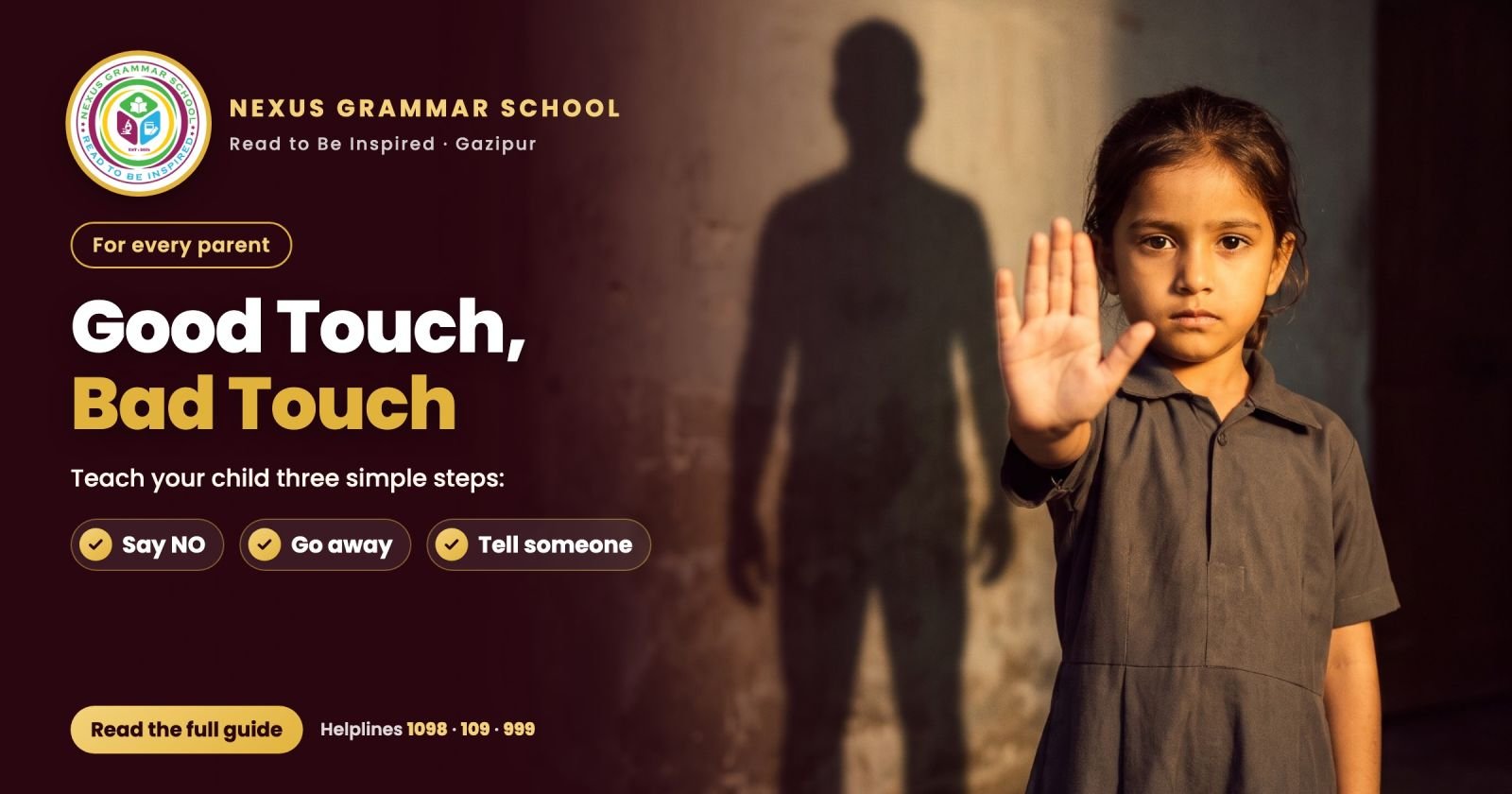
3. Three steps: Say No, Go Away, Tell Someone. If someone touches them in a bad way, they say "No", move away, and tell a trusted grown-up. Little children remember through rhythm and play, so practise it like a game, again and again.
4. A surprise is not a secret. A surprise, like a birthday present, is something everyone finds out about soon. That is fine. But if someone says "This is our secret, don't tell anyone" about touching or the body, your child must always tell you. Make it clear that telling is right, even if someone has frightened them.
5. "It is never your fault." Abusers often convince children that they are to blame, or that they will be in trouble if they tell. Reassure your child again and again: whatever happens, you will not be angry, and it is never their fault.
6. A list of trusted adults. Sit with your child and choose three or four grown-ups they can tell anything: at least two at home and at least one at school.
Warning signs to watch for
Children often don't say it in words, but their behaviour shows it. The girl in last week's news suddenly refused to go back. Watch for:
- Sudden fear of, or refusal to go to, school, tuition or a particular person
- Becoming withdrawn, crying, or getting angry or irritable without a clear reason
- Sleep problems, nightmares, or bedwetting long after it had stopped
- Sexual words or behaviour that are unusual for their age
- Pain, marks or discomfort around the private parts
- Unexplained injuries, or flinching from touch or sudden movements
- Wearing long or heavy clothes on hot days, as if to hide marks
- Unexplained gifts or money that the child wants to keep hidden
One sign alone does not mean abuse. But if you notice several together, talk to your child calmly.
If your child tells you something
How adults react the first time a child speaks up decides whether that child will ever speak up again.
- Stay calm. If your child sees fear or anger, they may go quiet.
- Believe them, and say: "You did the right thing by telling me. It is not your fault."
- Don't interrogate. Let them tell it in their own way, and don't keep repeating the same questions.
- Keep your child safe and away from the person involved.
- Don't take matters into your own hands. Go through the law. This gives your child the best chance of justice.
Get help, free of charge:
- Child Helpline: 1098
- National Helpline for Violence Against Women and Children: 109
- Emergency police: 999
How we teach it at Nexus Grammar School
For us, teaching body safety is as important as teaching reading. We teach it according to each child's age:
- Playgroup and Nursery: "My body, my rules", taught through stories, pictures and songs. Children learn to recognise which touches feel good and which feel wrong.
- KG and Primary: Children role-play "Say No, Go Away, Tell Someone", learn the difference between surprises and secrets, and make their own list of trusted adults.
- Regular reminders: We don't teach it once and stop. We revisit the topic in circle time several times a year.
- Prepared teachers: Our teachers are guided on how to listen calmly if a child speaks up, and who to report to.
We teach with confidence, not fear. We want every child to know that their body belongs to them, and that there are people at school who will always listen.
How we keep every child safe
Teaching children is only half the job. The other half is the adults around them. At Nexus Grammar School, safety is built into how we run the school every day.
Safeguarding comes first
- Every classroom is monitored by CCTV, so every class is under watch throughout the school day.
- Every staff member is required to report any suspected abuse or neglect. Reporting a concern is a duty, not a choice.
- Volunteers can speak up without fear. Anyone who helps at our school is encouraged to raise a safeguarding concern, and nobody faces any penalty from the school for doing so.
- Our staff are trained to notice the signs, such as unexplained injuries, a child flinching from touch or sudden movements, or a child wearing long clothes on a hot day to hide marks.
- Protection from all harm. Our school-wide measures are designed to protect every child from violence, exploitation, abuse and neglect.
A safe campus
- The way into school and every learning space is kept free from physical hazards.
- We carry out regular site inspections to find and fix risks and keep the campus healthy.
- Our washrooms and water facilities are kept safe, clean and well maintained.
Ready for emergencies
- We have clear procedures for evacuation, shelter-in-place and lockdown.
- After any emergency, children are safely reunited with their families through a clear, planned process.
- Children and staff practise fire, earthquake and lockdown drills regularly, so everyone knows the exit routes and the safe assembly points.
- The campus keeps first aid kits, drinking water, torches and emergency communication equipment ready.
- Teachers work in a buddy system, so that in a crisis no teacher and no class is ever on their own.
- We encourage parents who volunteer regularly to get First Aid and CPR certified, so there are even more trained hands on campus.
A final word
Child abuse is not a problem of one kind of institution or one area. It can happen anywhere, in any family. The first wall of protection is an aware child, with aware parents and teachers beside them.
Tonight, sit with your child for five minutes. Ask, as if telling a story: "If someone touched you in a way that made you feel bad, what would you do?" Listen to their answer, and tell them they can always tell you.
If you have any questions about child safety at our school, come and visit the campus. See the classrooms, meet our teachers, and see for yourself.
Come and visit us
Free assessments every Sunday and Tuesday, 10am – 1pm.